

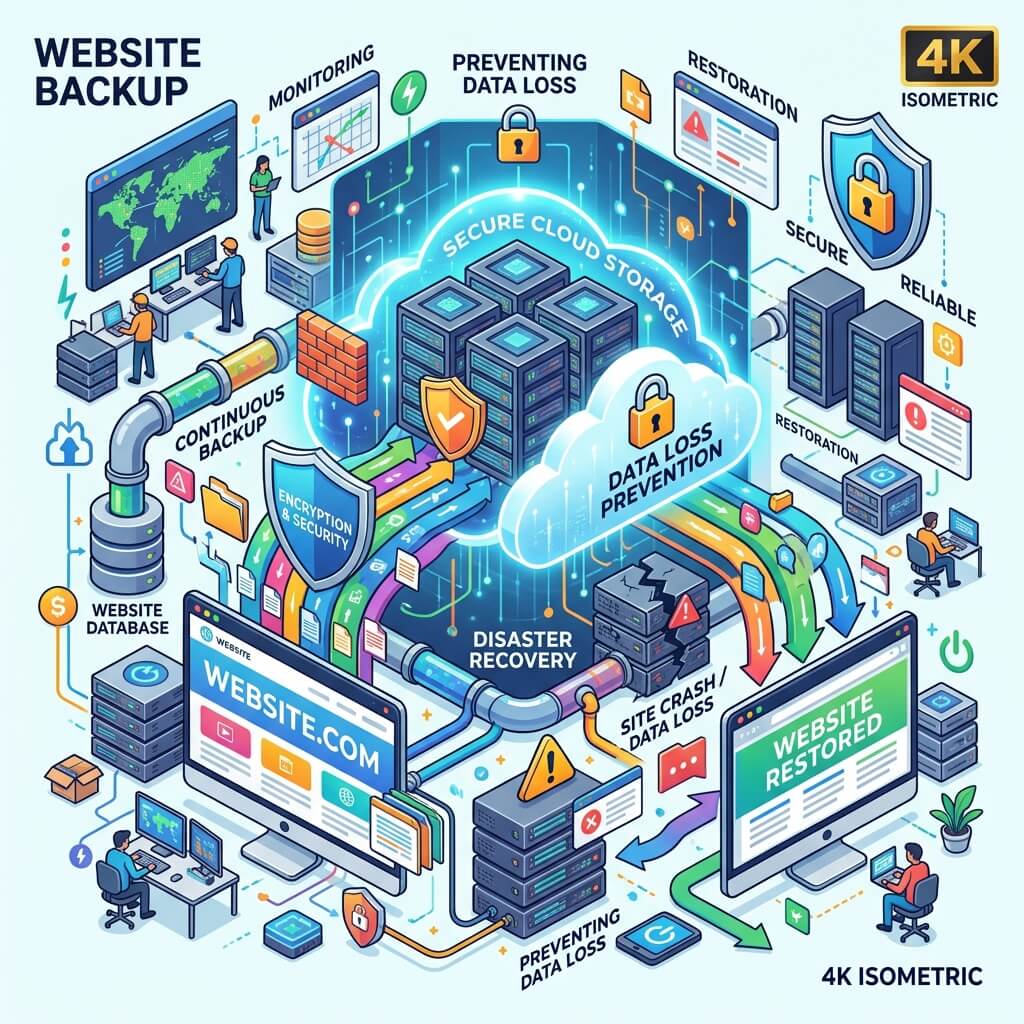
As a website owner, the most frightening scenario is this: You log into your system and see that your site has completely disappeared. Content built up over years, customer database, order history, all configurations — everything gone in an instant. This scenario is a real and frequently occurring problem in 2026. Natural disasters, server failures, cyber attacks, accidentally deleted files or faulty updates can trigger this catastrophe. A comprehensive backup and recovery strategy is your only real safeguard against these risks.
Why Backup Alone Isn't Enough: The 3-2-1 Rule
The 3-2-1 rule, the gold standard of professional backup management, remains valid in 2026:
- 3: There should be at least 3 copies of the data (1 original + 2 backups)
- 2: These copies should be kept on at least 2 different storage media
- 1: At least 1 copy should be physically at a different location (off-site)
Taking backups only on the same server won't protect you in a server failure. Taking only local backups won't help in case of fire, flood or earthquake. Real protection is provided by geographically distributed backups.
Backup Types
- Full Backup: Complete copy of all files and database. The most reliable but most storage-consuming method.
- Incremental Backup: Saves only data that has changed since the last backup. Fast and low storage; but recovery depends on the chain.
- Differential Backup: Saves all data that has changed since the last full backup. Balance between incremental and full backup.
- Snapshot: Records the exact state of the system at a specific moment. Enables very fast recovery in virtualization environments.
Backup Frequency: How Often is Enough?
The key criterion that determines backup frequency: the amount of data loss acceptable for your business (RPO — Recovery Point Objective). For example:
- E-commerce sites: Hourly or real-time backup — every order is critical
- Corporate websites: Daily backup is generally sufficient
- Blogs and static content sites: Daily or weekly depending on content update frequency
- Finance and health applications: Real-time replication is mandatory
Saying "I took a backup" isn't enough — testing the backup is essential. A backup that has never been tested for restoration may not work in a real crisis. Perform a test restore at least once a month and verify the process works.
Cloud-Based Backup Solutions
Corporate backup strategy in 2026 is almost entirely cloud-based. Leading solutions:
- Amazon S3: Object storage, extremely durable and cost-effective
- Google Cloud Storage: High availability with Google infrastructure
- Backblaze B2: Cost-focused alternative, ideal for large volumes
- Offsite backup services: Fully managed, SLA-guaranteed professional services
Disaster Recovery Plan (DRP)
A Disaster Recovery Plan (DRP) pre-determines what to do in a crisis. A good DRP includes:
- Recovery Time Objective (RTO): How long the system needs to be back up
- Recovery Point Objective (RPO): Maximum acceptable data loss period
- Responsibility matrix: Who does what in a crisis
- Recovery steps: Step-by-step restoration procedures
- Communication plan: How customers and stakeholders are informed
- Test schedule: DRP should be tested at regular intervals

