

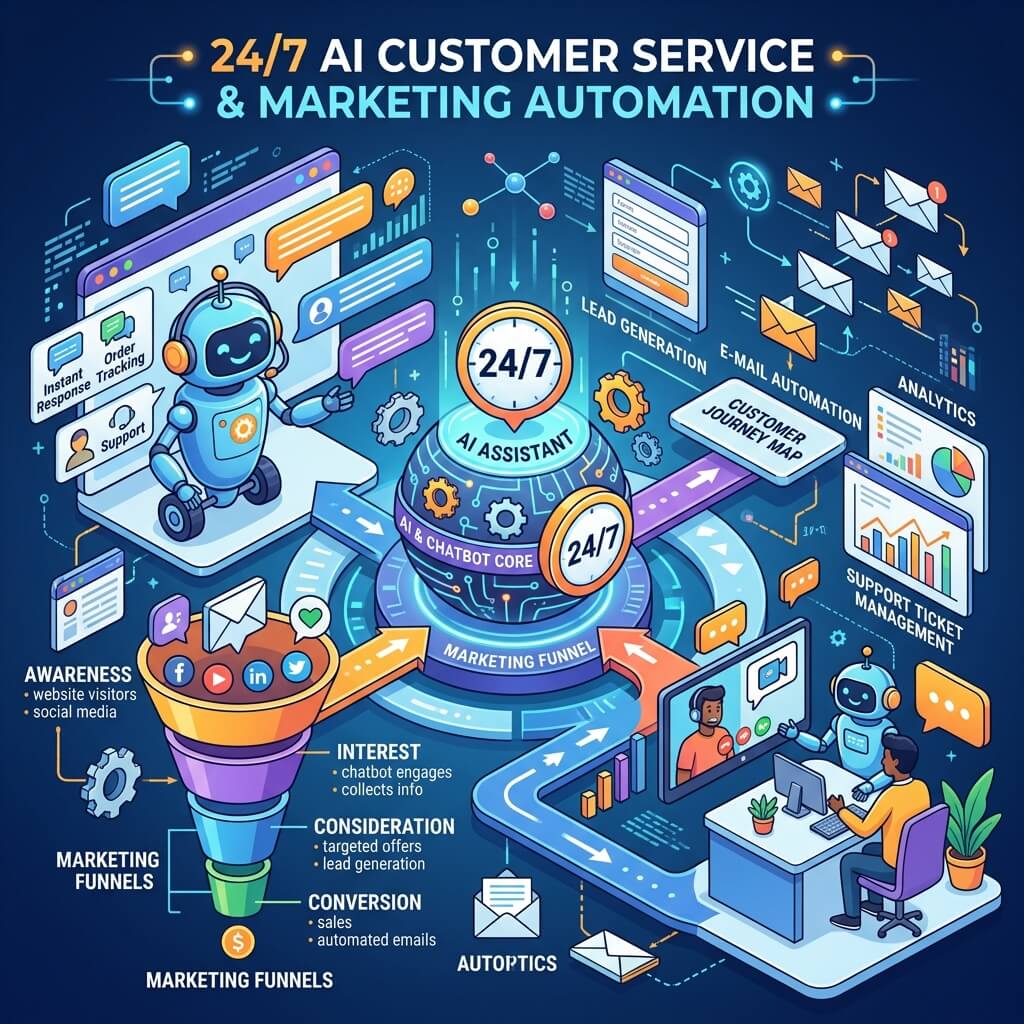
In 2026, AI-powered chatbots have fundamentally transformed customer service, sales processes and marketing automation. Now when a customer asks a question, they get a response in seconds rather than hours — and this response is often genuinely correct and helpful. With the widespread adoption of large language models (LLMs), chatbots have gone far beyond simple Q&A systems; they've become context-aware, personalized, and sales-focused assistants.
Where Chatbot Technology Has Arrived in 2026
The "rule-based" chatbots of a few years ago are long gone. The AI chatbots of 2026:
- Understand nuanced questions with natural language processing (NLP)
- Provide contextual responses by remembering conversation history
- Multi-language support — communicating with customers in their own language
- Detect dissatisfied customers with sentiment analysis
- Act as product recommenders — functioning as sales assistants
- Seamlessly transfer to human agents for complex issues
Chatbot Use Cases
Areas where businesses use chatbots most efficiently in 2026:
- Customer support: FAQ answering, order tracking, return and exchange processes
- Lead generation: Collecting and qualifying prospect information from visitors
- Sales assistant: Product recommendations, price comparisons and purchase guidance
- Appointment and reservation: Reservation management with automatic calendar integration
- Onboarding: Welcoming and guiding new customers or users
- Survey and feedback: Post-sale satisfaction measurement
Marketing Automation Flows
When you combine a chatbot with a marketing automation engine, prospect capture and conversion processes become fully automated. Powerful automation flows in 2026:
- Lead nurturing: Automatic email + WhatsApp + push notification series for form-filling visitors
- Re-engagement: Automatic reminders for customers who haven't transacted in 30 days
- Upsell/cross-sell: Complementary product suggestions after purchase
- Abandoned registration: Reminder notification for users who left a form halfway
- Birthday campaigns: Automatically personalized offers with CRM data
When calculating chatbot investment ROI, consider new revenue rather than support team savings. A well-designed sales chatbot is a revenue-generating tool more than a cost-cutting one.
Omnichannel Chatbot Integration
Successful chatbot strategy in 2026 doesn't work on a single channel — it works on every channel where customers are:
- Website live chat widget
- WhatsApp Business API chatbot
- Facebook Messenger bot
- Instagram DM automation
- Telegram bot
- In-app mobile assistant
Managing all these channels through a single central dashboard is the essence of 2026's omnichannel customer service approach.
Chatbot Setup and Success Metrics
KPIs you need to track to measure chatbot performance:
- Resolution Rate: Percentage of conversations the bot resolves without human intervention
- First response time: Average bot response speed
- CSAT (Customer Satisfaction Score): User rating after bot conversation
- Conversion rate: Sales or lead rate achieved via chatbot
- Transfer rate: Percentage of conversations redirected to human agents

